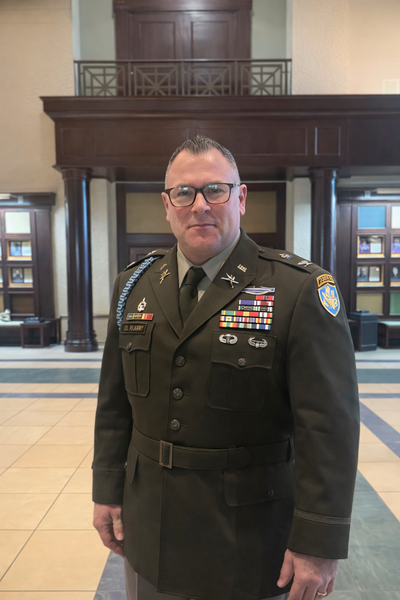
Nick Bilotta
What inspired your decision to pursue a master's degree in Adult Learning and Leadership at Kansas State University?
For the first half of my career, I looked for potential opportunities to further my education. It was tough just based on the time and what was going on in the world. I was afforded an opportunity to be a resident student at the Command and General Staff College at Fort Leavenworth in Kansas. We recognized that this was one of the only opportunities at the time at that college to pursue an advanced degree. I took advantage of it and did a little bit of research. There are plenty of opportunities at Fort Leavenworth through that program that they offered to students. It came down to a couple things. At this point in the Army, it was important for officers at that grade to pursue a master's degree. Pursuing a degree in what you wanted to do was equally as important, if not more important. That is really how I landed at K-State.
After completing the program, what career path did you follow?
After the program, I went back into the Operational Army and took on a position of greater responsibility. That was a significant shift from direct-level leadership for the first eight to 10 years in the Army to now, post-command general staff college and going down to being an organizational-level leader. I landed at Fort Drum, New York, as an operations officer for an infantry battalion of about 750 men and women who come from all walks of life. [They are] anywhere from 18, some 17 years old, to over 40 [years old]. Coming out of that program into an organizational-level leadership job was the recognition of the varying levels of experience of the adults I was working for and working with. It's an interesting dichotomy as a senior leader in the organization. There was an expectation that you know stuff and there were a lot of young folks that were looking at me and my peers for how to do stuff. I gained an appreciation for the levels of experience across the board. The assumption initially is the more military experience you have, the better you're going to be. I think I gained an appreciation of being able to tap into my work experience and the life experiences I brought to the job. I started to look into that more and value it. I think that was something significant that impacted the way I led from there on out.
What part of your master's degree program do you think contributed to your career?
I think from being a trainer, assessments were huge for me. We can go out and train all day long, but if we don't adequately assess that training, measure it and think through ‘how we're going to assess that’, then we might as well not do it. I brought the things that I've learned about assessing adults into my unit, and I carry that with me today. Like thinking through, developing evaluation criteria and thoughtful metrics to assess learning.
Is there a particular project or experience from the program that shaped your understanding of adult learning and leadership, especially in the context of your professional field?
The synergy between program planning and showing up every day and managing a near-, mid- and long-term training calendar. [Like] being thoughtful in how to develop training both in the near term and long term, how to assess that, what we are trying to achieve and how it's going to be most impactful. That was a constant, everyday training management program planning type of thought process that the program absolutely contributed to. I was able to spread that amongst the staff when we were planning training. I could go on for hours about experiences. The research project that we did wasn't just doing the research; it was learning how to do the research. I've found that to be extremely valuable since I left the program. I was a student at the Navy War College a year ago, and I tapped back into how to do research from my time at K-State. Several different aspects of that program contributed to getting here today.
Could you share a specific instance where you applied insights from the program to address a real-world challenge in adult education?
When I took Battalion Command, I fell into a very high-performing organization that had just returned from a deployment, and the guys were experienced. It was a very good organization. It's customary for an incoming commander to receive in-briefs from your staff sections and the leaders across the organization, and specifically from subordinate company commanders to deliver that in-brief to the new battalion commander. I put a lot of thought into how I wanted to go about doing that and what I came to was [that] I wasn't going to dictate what that looked like, I was not going to publish specific guidance on what exactly it should look like or what the slides should be. The only guidance I gave them was ‘I want to get to know you, get to know your team, and you can tell me whatever you think is important that I should know’ and that was it. By design, I was trying to get after, ‘hey, show me [you’re] a critical thinker, come back to me with this.’ I can immediately sense the frustration in some leaders who expected to fill out slides and these metrics and run the numbers. [Even though] it's important information, I was more interested in getting to know the people and seeing how they address it. It was a really cool experience. Tying it back to the program was [that] we're trying to develop critical thinkers and problem solvers. The reality is we're training for combat and every day is important and there's no checklist on the battlefield. If you're out of communications with your higher headquarters, you're going to have to solve a problem, think on your feet, think critically and come up with some creative solutions. I tried to carry forward with a lot of other activities that we would do across the organization to grow that mindset and motivate young men and women. We always talk about being self-directed, and I would find those people who would sink their teeth into something and come back to me with a new idea. I think both sides benefited from that exercise or experience. That's something I could tie back to school.
What advice would you offer to prospective students who are considering the program in adult learning and leadership based on your experience as a student?
My advice would be to do your homework. Investigate what you're signing up for. I was a young man once who knew that you had to have a master's degree, and no one really cared what it said, as long as you had that on your file. If you're going to [go to school], do it for yourself and for the people you're charged with leading. Invest in yourself. Find something that is relevant, [something] that will interest you, [something] that you're going to enjoy and then you can share with the world on the backside. I think my advice is to look into it and make a thoughtful decision. Be very deliberate about it. It's tough to argue how this program does not relate to what you do as an adult. If [getting higher education] isn't at the top of your list, you should probably re-think that. It is relevant in so many ways and can be applied across your day-to-day life. As a parent, as a leader, as a coach, teacher, trainer — the opportunity to learn is there. That would be my advice. Be very deliberate and thoughtful about your choices, and consider K-State because it is relevant to everything that we do.